Table of contents
- 01What Is the A2A Protocol?
- 02Why AI Agents Need an Interoperability Protocol
- 03Why A2A Matters Now in 2026
- 04A2A vs MCP: The Most Important Distinction
- 05The Core Building Blocks of A2A
- 06How the A2A Protocol Works Step by Step
- 07Authentication and Authorization Are Different
- 08A2A Security Model for Production Systems
- 09Prompt Injection Does Not Disappear with A2A
- 10A2A + MCP Production Architecture
- 11A Practical Multi-Agent Example
- 12Failure Handling in A2A Systems
- 13Idempotency Is Critical for Agent Actions
- 14Observability for Multi-Agent Systems
- 15Where A2A Fits in the Open Agent Stack
- 16A2A vs MCP vs UCP vs AP2
- 17A2A and the Agentic AI Foundation
- 18Best Use Cases for the A2A Protocol
- 19When Should You Use A2A?
- 20When You Probably Do Not Need A2A
- 21Common A2A Implementation Mistakes
- 22A2A Production Architecture Checklist
- 23A2A Migration Strategy
- 24How A2A Changes Multi-Agent Architecture
- 25A2A and Structured Outputs
- 26A2A and Generative UI
- 27Visualizing A2A Payloads and Agent Data
- 28What Comes Next for A2A?
- 29Is A2A the Future of Multi-Agent Systems?
- 30Frequently Asked Questions
- 31Conclusion
- 32Build Production AI Agent Systems
- 33References
A company may build one agent with Google's Agent Development Kit, another with LangGraph, another with a custom Python service, and a partner may operate its own agent using an entirely different technology stack.
Each agent may work perfectly on its own.
The challenge begins when they need to work together.
How does one agent discover what another agent can do? How does it delegate work? How does it track a long-running task? How does it exchange structured data, files, or status updates without knowing the other agent's internal memory, prompts, tools, or framework?
This is the problem the Agent2Agent Protocol — A2A — is designed to solve.
A2A provides a common communication layer for independent AI agents.
Instead of forcing every company to build custom integrations between every pair of agents, A2A defines a shared model for capability discovery, agent communication, task delegation, status tracking, streaming, structured outputs, files and media, authentication, and interoperability.
In 2026, the protocol has moved beyond its early experimental stage. A2A v1.0 is the stable, production-ready generation of the specification, with capabilities aimed at enterprise deployments including stronger identity mechanisms, multi-tenancy, multiple protocol bindings, and version negotiation.
A2A has also joined the Agentic AI Foundation, placing it alongside other major pieces of the emerging open agent infrastructure. That makes A2A one of the most important technologies to understand if you are building multi-agent applications in 2026. For more context, you can explore our AI agent guide or learn how JSON Schemas enable structured communication.
What Is the A2A Protocol?
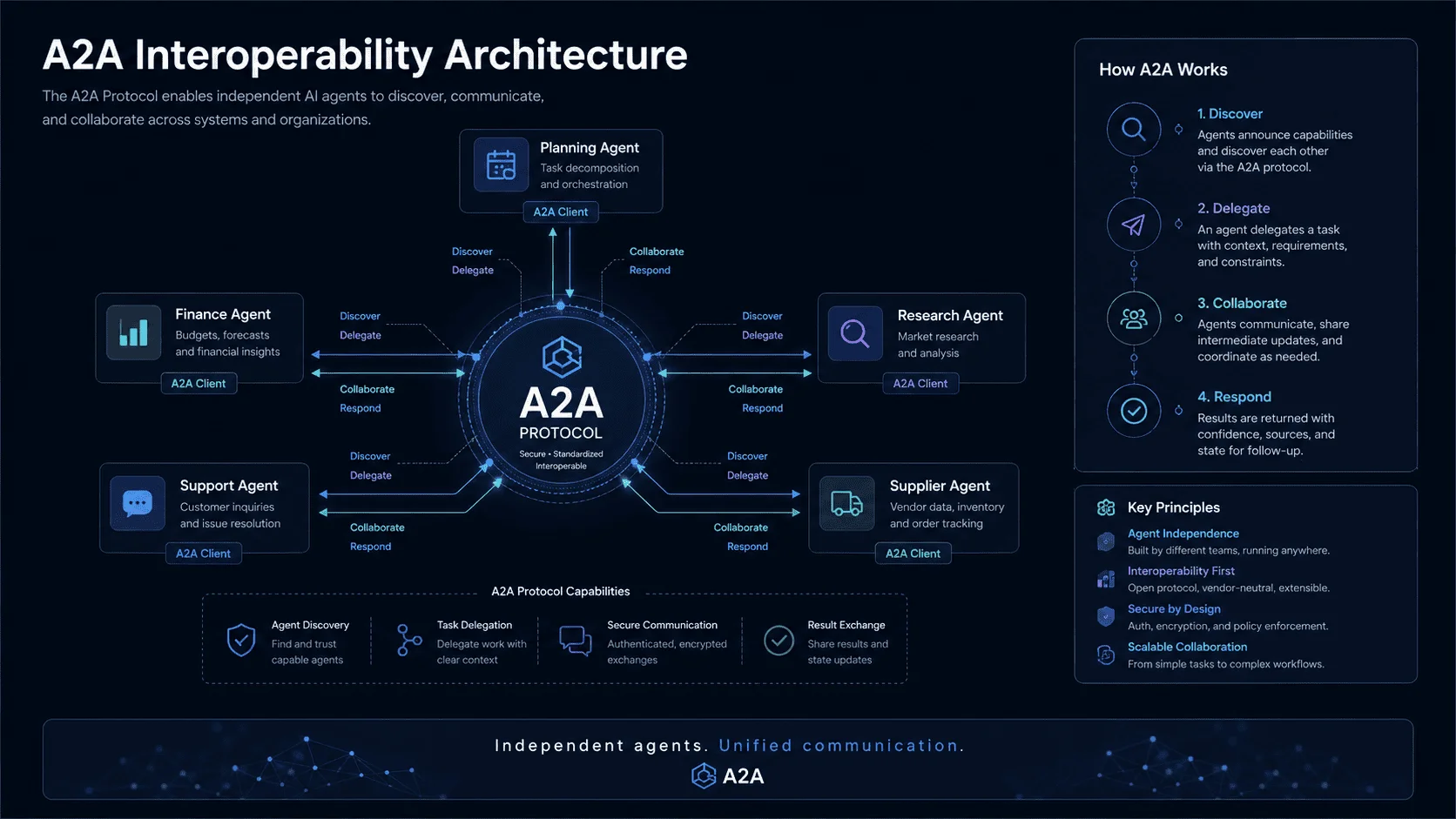
The Agent2Agent Protocol is an open standard that lets independent AI agents communicate and collaborate without requiring either agent to expose its internal implementation.
An agent does not need to know the other agent's prompt, internal memory implementation, model provider, orchestration framework, database architecture, private tools, or source code.
Instead, agents interact through a standardized protocol. A2A provides a shared external contract while agents remain internally opaque. This separation is important.
Why AI Agents Need an Interoperability Protocol
Imagine a travel-planning agent. The user says: "Plan a five-day business trip and keep the total under $2,500." The main agent may need help from a flight agent, hotel agent, calendar agent, company travel-policy agent, and expense agent.
Without interoperability standards, every integration becomes custom, creating integration costs, vendor lock-in, fragile APIs, duplicated authentication logic, inconsistent task semantics, and difficult monitoring.
With an agent-to-agent protocol, the Travel Agent communicates through A2A to the Flight, Hotel, Calendar, and Expense agents. The point is not that every system becomes identical, but that they understand the same communication contract.
Why A2A Matters Now in 2026
A2A has reached the v1.0 generation, designed as the stable production-ready milestone. The protocol has expanded its enterprise capabilities, joined the Agentic AI Foundation, and is increasingly positioned as one layer of a larger open agent stack.
The significance is not simply that agents can send each other messages; the more important development is that agent interoperability is starting to become infrastructure, as organizations increasingly need to connect internal, SaaS, partner, cloud, departmental, and customer-facing agents without forcing all of them onto one vendor.
A2A vs MCP: The Most Important Distinction
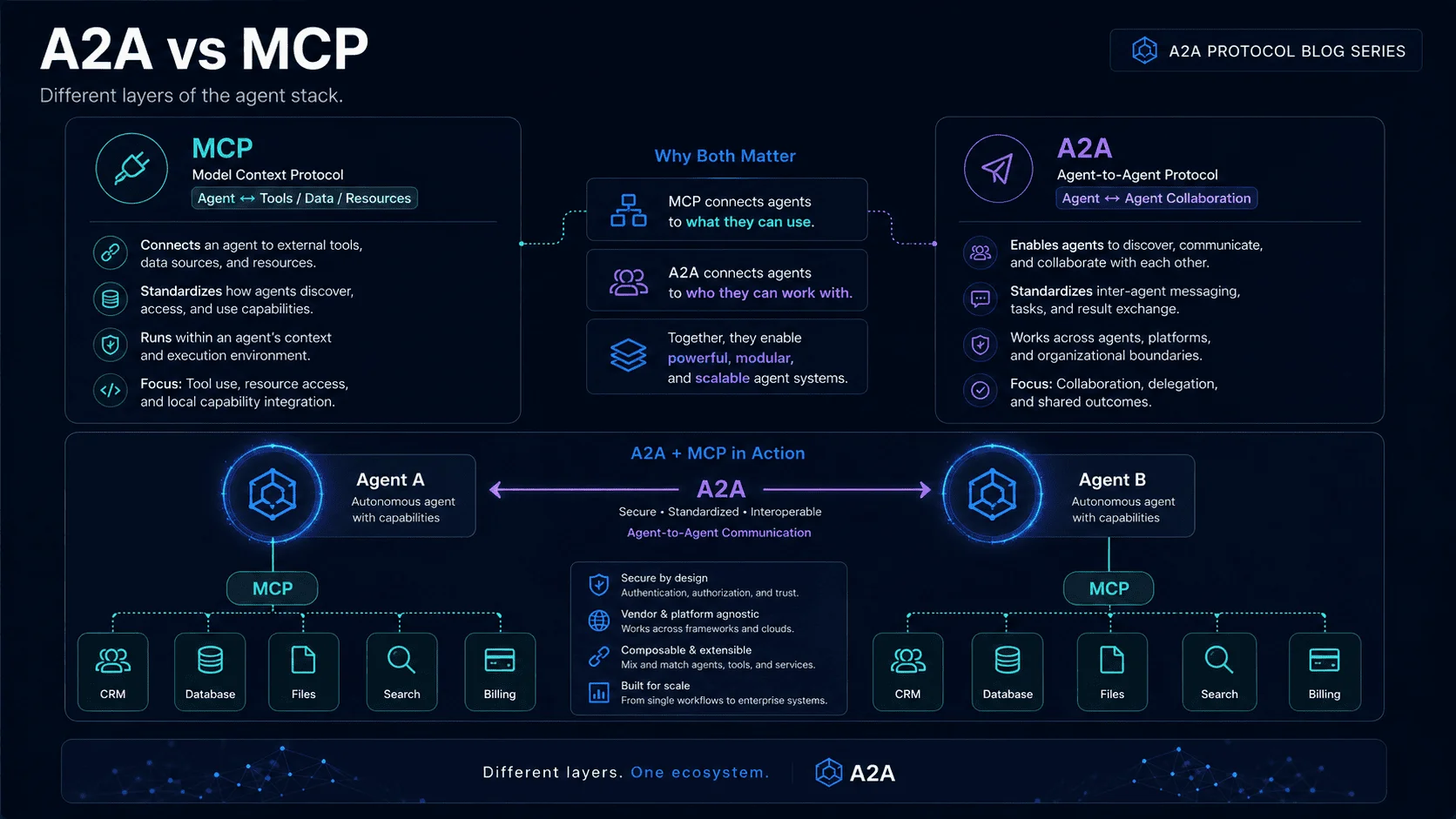
A2A and MCP are complementary. A2A does not replace MCP.
The Core Building Blocks of A2A
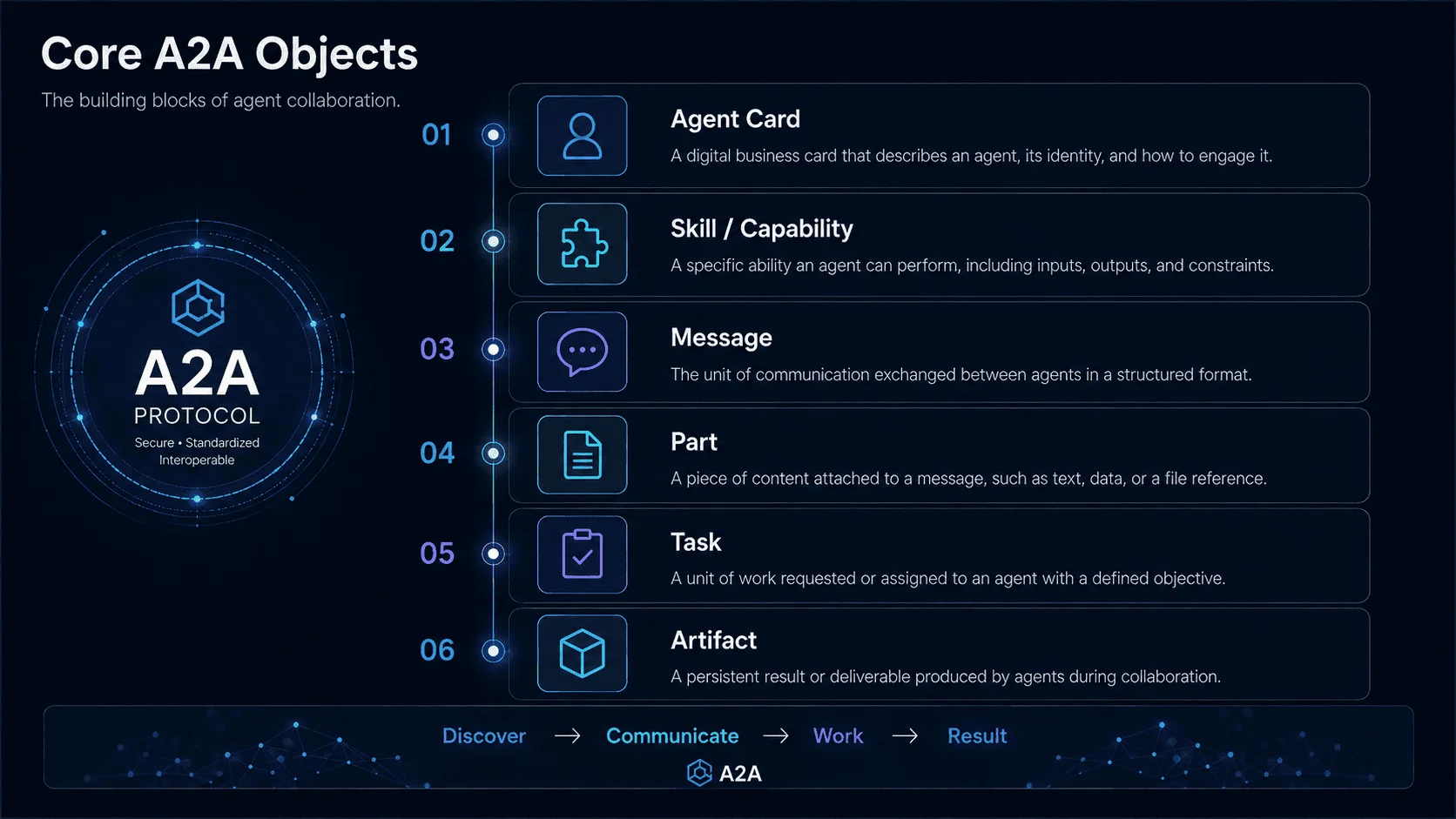
To understand how A2A works in practice, we need to look at the primary objects defined by the protocol. These building blocks provide a shared vocabulary for agent interaction.
To understand how A2A works in practice, we need to look at the primary objects defined by the protocol. These building blocks provide a shared vocabulary for agent interaction.
1. Agent Card
An Agent Card is how an A2A-compatible agent advertises information about itself. Conceptually, it tells clients who the agent is, where it can be reached, which interfaces it supports, its capabilities, and security information. Think of it as a machine-readable capability profile.
// Conceptual Agent Card (Simplified)
{
  "name": "Invoice Analysis Agent",
  "description": "Analyzes invoices and detects anomalies",
  "skills": [
    {
      "id": "analyze_invoice",
      "name": "Analyze Invoice"
    }
  ]
}
In A2A v1.0, the protocol has also strengthened the identity and trust capabilities around Agent Cards, ensuring that organizations can verify the source and integrity of the agents they collaborate with.
2. Agent Skills
An agent can advertise specific capabilities or skills. For example, an Invoice Agent might advertise skills like "extract invoice fields," "validate totals," "detect duplicates," and "classify expenses." Other agents use these advertised capabilities to decide whether delegating a particular sub-task makes sense.
3. Message
Messages carry communication between the client and the agent. A message can contain one or more "Parts" and is used for initial requests, clarifications, additional instructions, or progress updates. An important distinction in A2A is that messages are not the primary mechanism for durable task results; the protocol separates ongoing communication from formal task outputs.
4. Part
A Part is a content container within a message. It can represent various forms of content, including text, structured JSON data, files, and URLs. This allows agent interactions to move beyond plain chat; for instance, an invoice-processing agent might receive text instructions, a PDF document, and JSON metadata all within the same interaction.
5. Task
The Task is the core unit of action in A2A. It represents work being performed by an agent. Since many agent operations are not instant—such as researching hundreds of documents, generating a long report, or negotiating with another agent—Tasks provide a durable way to track that work through a defined lifecycle.
Other outcomes can include FAILED, CANCELED, REJECTED, or INPUT_REQUIRED, allowing for complex, long-running agent workflows.
6. Artifact
Artifacts represent the concrete outputs produced by Tasks. This could be a generated report, a JSON result, a spreadsheet, or an image. The A2A mental model is clear: Message is for communication, Task is for the work itself, and Artifact is the result of that work.
How the A2A Protocol Works Step by Step
To understand the end-to-end flow of A2A, let's look at a clear example. Imagine a Procurement Agent that needs a quote from a Supplier Agent.
- 1Procurement Agent discovers Supplier Agent
- 2Reads Agent Card
- 3Checks advertised capabilities
- 4Sends request
- 5Supplier Agent creates Task
- 6Task enters WORKING state
- 7Supplier Agent requests input if required
- 8Client provides additional information
- 9Supplier Agent creates Artifact
- 10Task becomes COMPLETED
Step 1: Agent Discovery
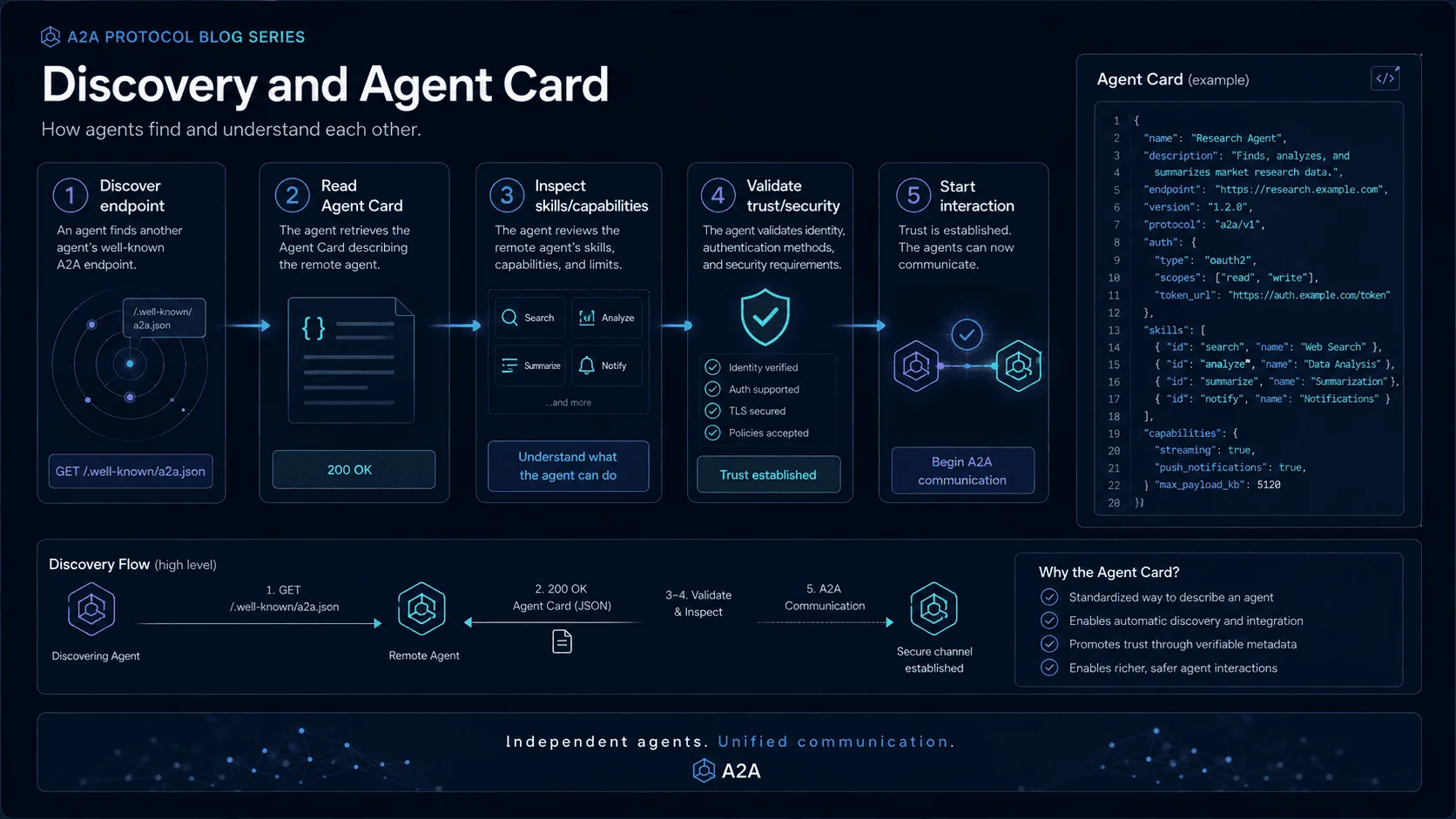
The client first needs to know how to reach an agent and what it supports. The Agent Card acts as the discovery/capability document.
Clients should not blindly trust an unknown agent simply because an Agent Card exists. Identity and security still matter in a production environment.
Step 2: Capability Selection
The client examines available skills/capabilities. This allows agents to advertise narrow, understandable responsibilities.
The client selects the capability appropriate for the user goal and proceeds to the next step.
Step 3: Sending the Message
The client sends a Message containing the request. The remote agent can return a direct Message for simple work or create a Task for more complex or asynchronous work.
// Simplified Conceptual Example
{
  "role": "user",
  "parts": [
    {
      "text": "Quote 500 units of product A."
    }
  ]
}
Step 4: Task Creation and Lifecycle
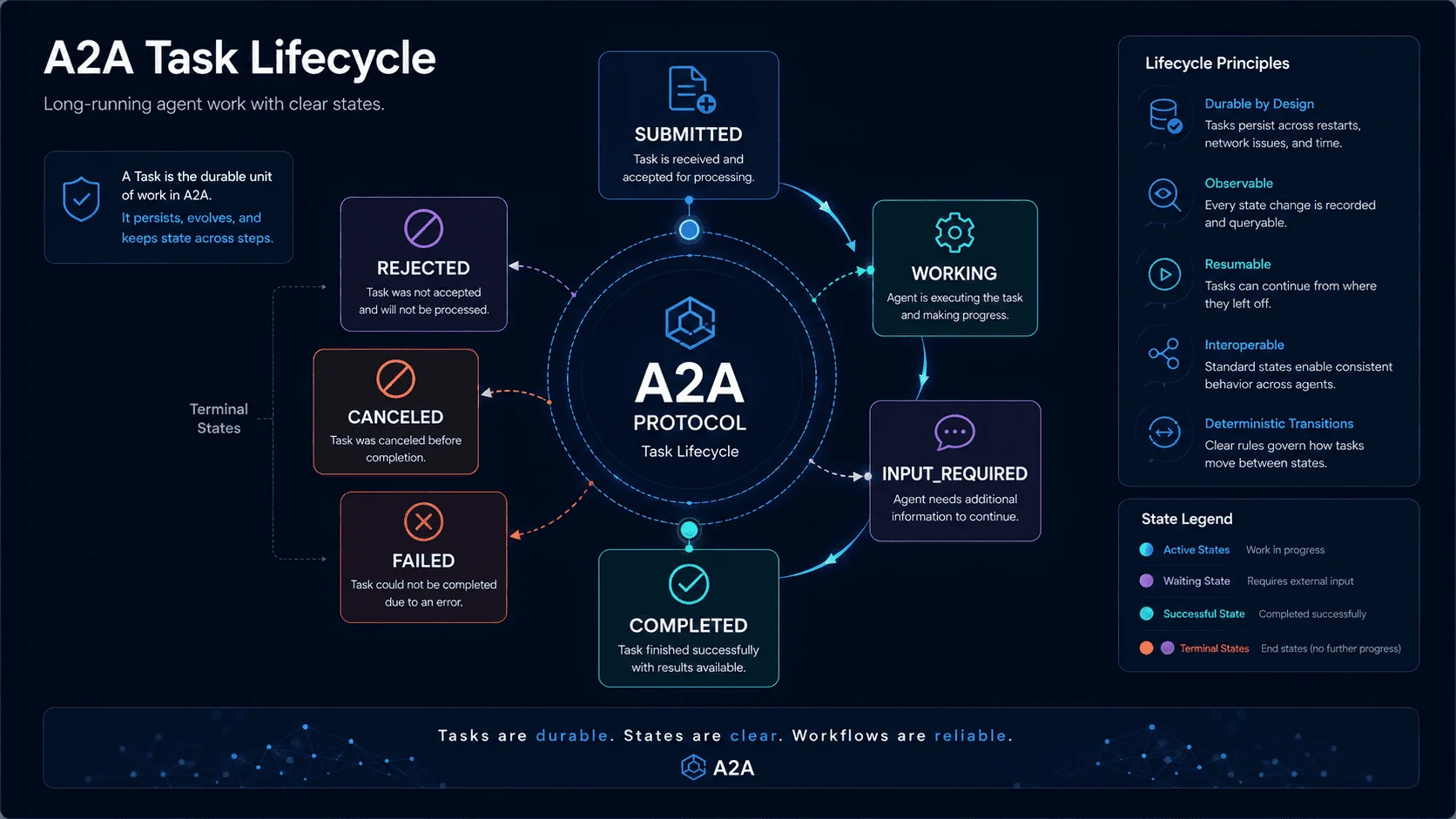
The major states in an A2A task lifecycle define how work is acknowledged and processed.
| State | Meaning |
|---|---|
| SUBMITTED | Work acknowledged |
| WORKING | Agent actively processing |
| INPUT_REQUIRED | More information is needed |
| COMPLETED | Work completed successfully |
| FAILED | Execution failed |
| CANCELED | Task canceled |
| REJECTED | Agent declined the work |
The INPUT_REQUIRED state is particularly important. For example, a supplier agent might ask: "Which delivery location should I use?" The client responds, and the same task can continue rather than starting an entirely unrelated conversation.
Step 5: Receiving Results as Artifacts
Durable task results should be represented as artifacts. This could be a document, spreadsheet, image, structured data, or multiple artifact parts.
// Example Quote Artifact
{
  "supplier": "Example Manufacturing",
  "quantity": 500,
  "unitPrice": 17.40,
  "estimatedDeliveryDays": 8
}
Polling, Streaming, and Push Notifications
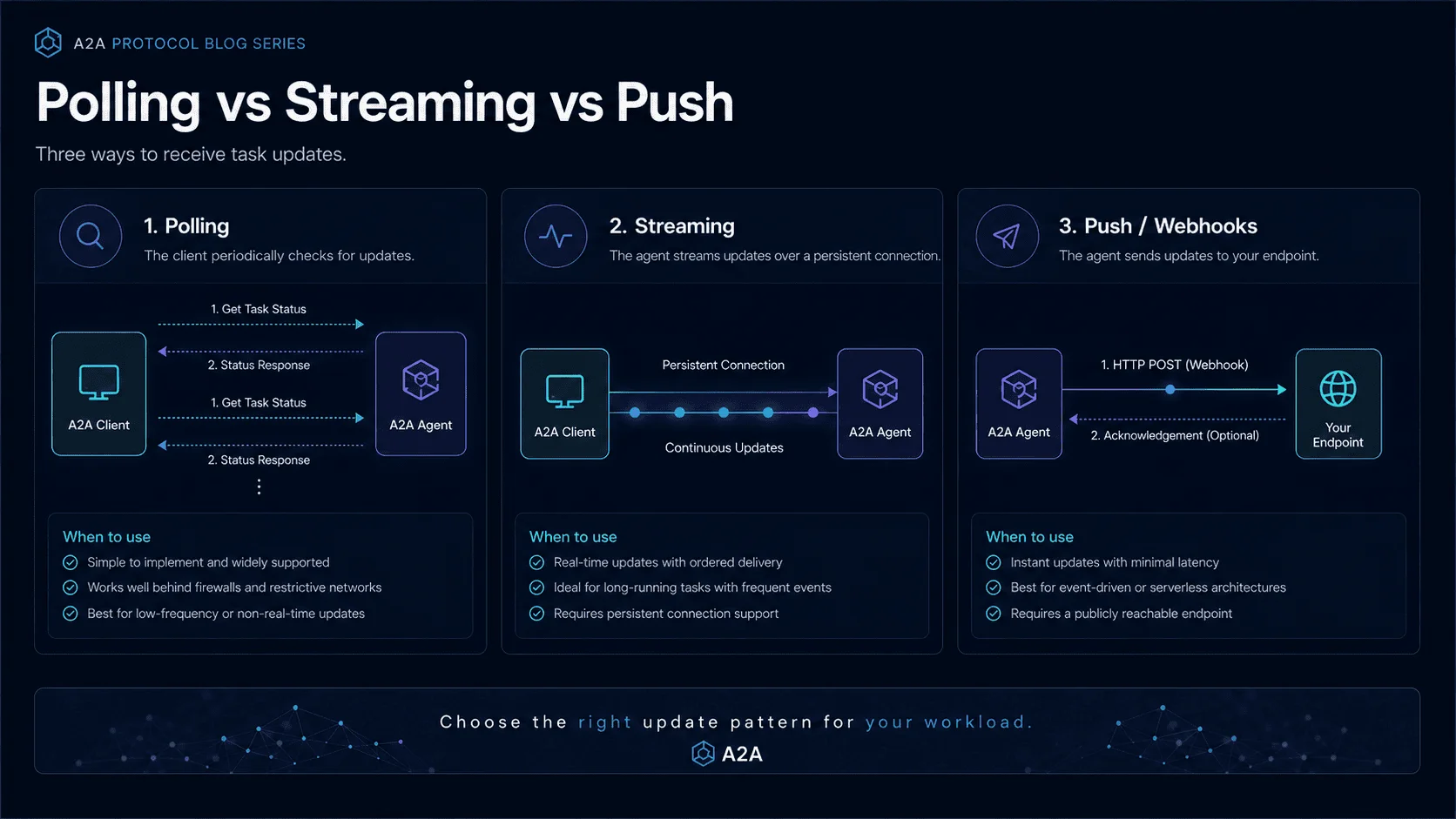
A2A supports multiple interaction patterns rather than forcing every workload into synchronous request/response.
Polling
Client periodically checks task status. Good for simple integrations and low-frequency tasks, but may create unnecessary requests.
Streaming
Client receives live status/artifact updates. Good for interactive applications, long tasks, and a live UX.
Push Notifications / Webhooks
Agent can notify an external endpoint about task changes where supported. Good for asynchronous workflows and disconnected clients.
A2A v1.0 and Multiple Protocol Bindings
A2A v1.0 was designed for heterogeneous enterprise environments. The protocol supports multiple bindings—such as HTTP/JSON, JSON-RPC, and gRPC—instead of assuming every organization uses one technology stack.
This means a Java enterprise service and a TypeScript SaaS platform can participate in the same interaction model without needing identical implementation stacks.
Version Negotiation
A2A v1.0 improves version-management behavior. If Agent A upgrades while Agent B has not yet updated, version negotiation allows capabilities to be handled more deliberately without requiring synchronized cutovers.
However, teams should still roll out gradually and avoid assuming every partner updates simultaneously.
Multi-Tenant A2A Architecture
Multi-tenancy is crucial for SaaS companies. One service infrastructure may support multiple customer contexts.
Security requirements demand that tenants come from trusted context, and one tenant should never access another tenant's tasks or artifacts. The protocol itself does not automatically solve application-level tenant isolation.
Signed Agent Cards and Agent Identity
A2A v1.0 adds stronger mechanisms for verifying agent identity. A signed Agent Card allows a client to validate trust before an interaction begins.
Authentication and Authorization Are Different
Authentication answers: "Who is calling?" Authorization answers: "What is the caller allowed to do?"
A Procurement Agent may be authenticated correctly, but it may only be authorized to request quotes—not place orders over $10,000.
Note that structured contracts (like the ones described in our JSON Schema guide) help validate payloads but do not replace authorization.
A2A Security Model for Production Systems
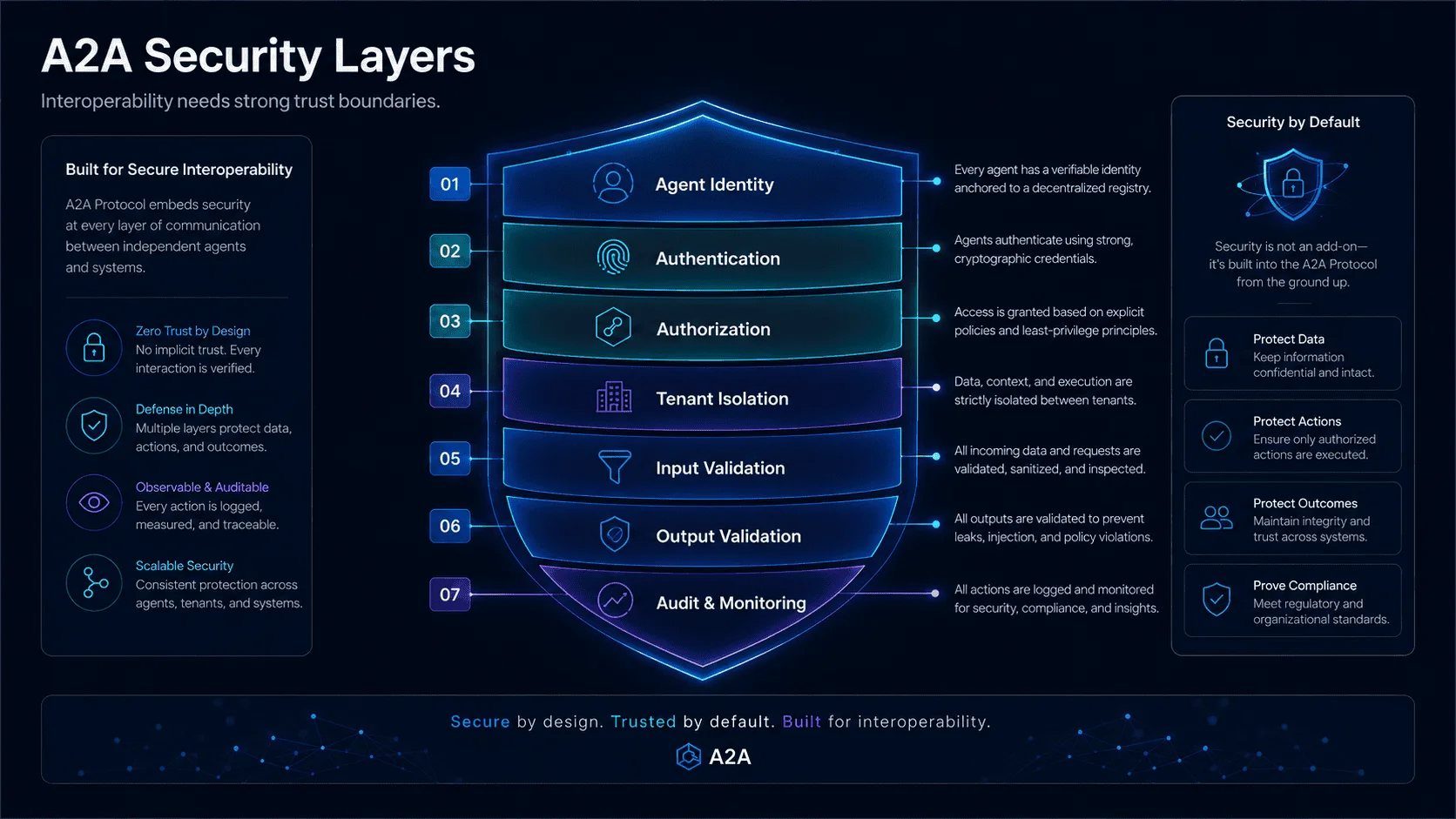
A secure production environment requires a defense-in-depth strategy.
- Least Privilege: Expose only necessary capabilities.
- Agent Identity: Verify who is communicating.
- Tenant Isolation: Keep customer context separate.
- Authorization: Check permission for every sensitive operation.
- Input Validation: Treat agent messages as untrusted external data.
- Output Validation: Validate structured results before using them.
- Rate Limiting: Prevent abuse and runaway agent loops.
- Timeouts: Do not allow remote tasks to wait indefinitely.
- Audit Logging: Record important task/action transitions.
- Approval Gates: Require human or policy approval for high-impact operations.
Prompt Injection Does Not Disappear with A2A
A remote agent may have consumed untrusted webpage content, emails, documents, or tool results. Information it sends to your agent should not automatically become trusted instructions.
Your agent must treat that as data, not automatically as authorization. Agent interoperability increases connectivity; it does not eliminate trust boundaries.
A2A + MCP Production Architecture
A2A handles agent collaboration. MCP handles tool/resource integration inside each agent's domain. This separation lets organizations combine specialized agents without forcing one protocol to solve every layer.
A Practical Multi-Agent Example
Scenario: Customer asks: "Can we upgrade 250 employees to the enterprise plan next month?"
Each agent may use MCP internally for its own systems.
Failure Handling in A2A Systems
Robust systems expect and manage failures gracefully. Key failure categories include: remote agent unavailable, timeout, malformed response, unsupported capability, authorization failure, task failure, and input required.
- Identify failure category.
- Preserve task state.
- Avoid silent retry loops.
- Use bounded retry policies.
- Apply idempotency to side effects.
- Notify user when input is required.
- Escalate high-risk ambiguity.
Idempotency Is Critical for Agent Actions
If a network timeout occurs after create_purchase_order, the client must not blindly call it again and accidentally create a duplicate purchase.
Observability for Multi-Agent Systems
Tracing becomes especially important when one user request crosses several agents.
- Monitor task success/failure/duration rates.
- Track input-required, cancellation, and availability rates.
- Alert on auth/version errors.
Logs | Metrics | Traces | Task IDs | Context IDs
A2A Does Not Expose an Agent's Internal Reasoning
A critical design principle of A2A is that it is an interoperability protocol, not an inspection protocol. It does not require an agent to expose its private chain-of-thought, internal prompts, hidden reasoning, memory implementation, or proprietary orchestration logic. Agents communicate through defined external interfaces, allowing independently developed systems to connect securely while maintaining their internal opacity.
The A2A Protocol provides a shared contract while agents remain internally opaque.
Where A2A Fits in the Open Agent Stack
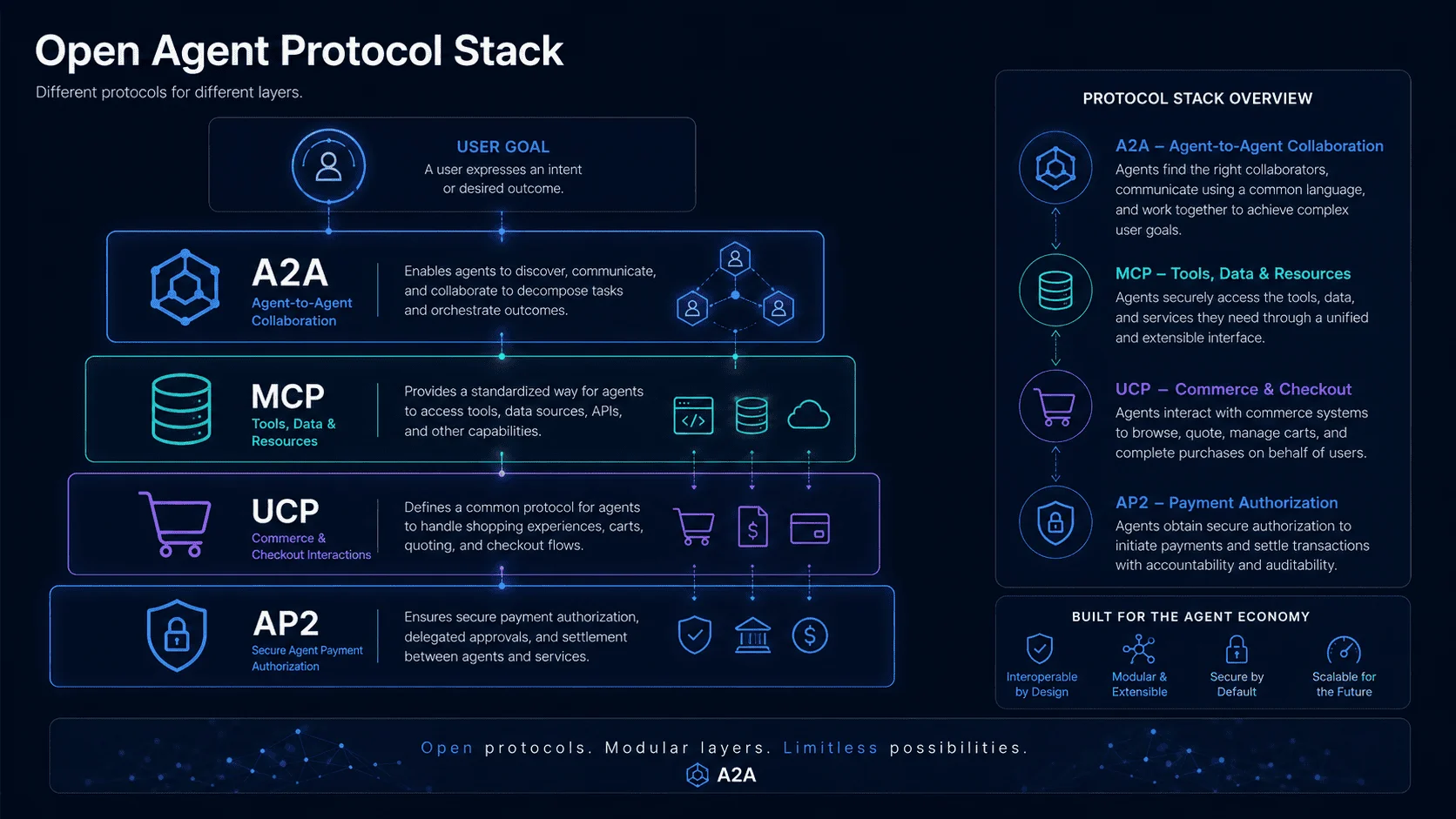
No single protocol needs to handle every layer. The emerging open agent stack defines clear boundaries between different types of communication.
MCP
Connects an Agent to Tools, Data, and Services.
A2A
Connects an Agent to Another Independent Agent.
A2A and MCP are complementary parts of the open agent stack.
These protocols solve different problems, and not every agent application needs all of them. The power of the stack lies in the ability to pick the right tool for each boundary.
A2A vs MCP vs UCP vs AP2
| Protocol | Primary Role |
|---|---|
| MCP | Agent ↔ tools/data/resources |
| A2A | Agent ↔ agent collaboration |
| UCP | Commerce interactions / checkout interoperability |
| AP2 | Secure, verifiable agent-payment authorization |
A production system may combine several of these. For example, a Restaurant Manager Agent might use MCP to read inventory, A2A to contact supplier agents, UCP to structure a commerce interaction, and AP2 to provide verifiable payment authorization.
A2A and the Agentic AI Foundation
In August 2026, A2A joined the Agentic AI Foundation as a hosted project. This move to neutral governance is a critical milestone for the ecosystem.
Interoperability standards should not depend on a single vendor. Organizations need the confidence that the technical contracts they rely on are transparently evolved and supported by a broad group of technology companies. A2A now sits in the same broader open-agent ecosystem as MCP, though they remain distinct technologies for different use cases.
Best Use Cases for the A2A Protocol
Enterprise Agent Collaboration
Within a large organization, specialized agents can delegate work. For example, an HR agent might delegate a specific payroll question to a dedicated payroll agent using A2A.
Cross-Company Workflows
A2A enables a buyer agent from one company to communicate directly with a supplier agent from another, even if they use entirely different model providers.
Multi-Cloud Agents
When agents are hosted on different infrastructure (e.g., one on Azure and another on AWS), A2A provides the secure communication layer for their collaboration.
Supply Chain & Logistics
A planning agent can coordinate between multiple agents representing suppliers, logistics providers, inventory systems, and purchasing departments.
Financial Services
Specialized agents can coordinate research, compliance, risk assessment, and operations within strong, standardized authorization boundaries.
Software Engineering
A high-level planning agent can delegate specific implementation tasks to coding, security auditing, QA, and deployment agents.
When Should You Use A2A?
You should consider implementing A2A when:
- Two or more independent agents need to communicate.
- Agents are built with different frameworks or hosted by different vendors.
- Agents live across organizational boundaries.
- Automated capability discovery is useful for your workflow.
- Long-running task tracking and status updates are required.
- You want vendor-independent interoperability.
When You Probably Do Not Need A2A
Do not add protocol complexity unnecessarily. You may not need A2A in the following scenarios:
- One Application, One Agent: If a single agent talks directly to local services, use normal application code or MCP.
- Internal Functions: Calling a standard function inside your own application code does not require an agent protocol.
- Simple Tool Integration: If the other system is a tool rather than an autonomous agent, MCP or a normal REST API is a better fit.
- Latency-Sensitive Internal Calls: A direct internal service call is often simpler and faster where there is no interoperability requirement.
Common A2A Implementation Mistakes
1. Treating A2A as a Replacement for MCP
A2A connects agents to agents; MCP connects agents to tools. Using the wrong protocol for the job leads to architectural friction.
2. Trusting Every Discovered Agent Automatically
Discovery does not equal trust. Always implement a verification layer before delegating sensitive tasks.
3. Using Agent Identity as Authorization
Knowing who an agent is doesn't mean they are allowed to perform every action. Implement granular permissions.
4. Skipping Tenant Isolation
Ensure that agent messages and tasks are strictly scoped to the correct user or organization tenant.
5. Blindly Retrying Side Effects
Non-idempotent actions should not be retried automatically without careful state management.
6. Treating Messages as Durable Task Results
Messages are for communication; Task objects are for state. Don't rely on message logs to reconstruct task status.
7. Ignoring Task State
Failing to handle task cancellations or timeouts leads to "zombie" processes that consume resources.
8. Building One Giant Agent
Instead of one "god agent," build specialized agents with clear responsibilities and narrow capabilities.
9. Logging Sensitive Payloads Without Controls
Agent communication often contains PII. Ensure your logging and observability stack respects privacy boundaries.
10. Forgetting Business-Level Validation
Protocol validity is not business validity. Always validate agent outputs against your specific business rules.
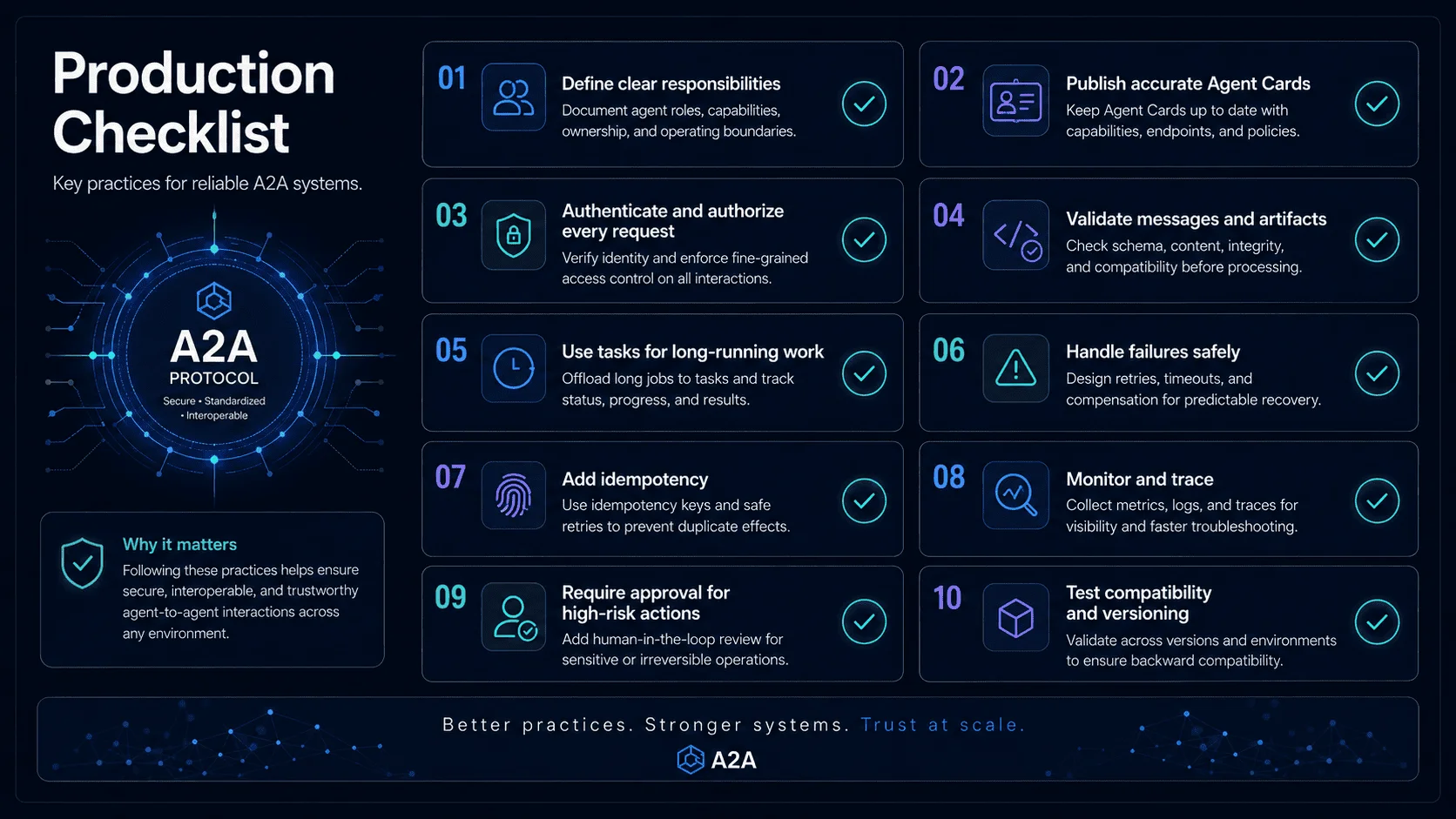
A2A Production Architecture Checklist
A2A Migration Strategy
For teams already using custom agent integrations, we recommend a gradual migration rather than a full rewrite:
- Inventory: Identify all existing agent-to-agent communication points.
- Separate: Distinguish between true agent interactions and standard API calls.
- Define: Create Agent Cards and capability manifests for your internal agents.
- Map: Translate long-running work into the A2A Task model.
- Boundary: Introduce A2A on one organizational boundary first.
- Expand: Gradually scale the protocol across the rest of your agent network.
How A2A Changes Multi-Agent Architecture
Multi-agent architecture is shifting from centralized models to distributed networks.
Old Approach (Centralized)
Central Orchestrator
  ├── custom integration A
  ├── custom integration B
  ├── custom integration C
  └── custom integration D
A2A Approach (Networked)
Agent Network
  A ↔ B
  A ↔ C
  B ↔ D
  C ↔ D
This does not mean central orchestration is dead; rather, A2A provides standardized communication boundaries regardless of the orchestration pattern you choose.
A2A and Structured Outputs
Interoperability becomes much more reliable when agent artifacts and application actions use explicit structured contracts. A2A defines the interaction model, while JSON Schemas define what application data should look like.
A2A and Generative UI
A2A helps agents cooperate, while Generative UI helps an agent present interactive experiences to users. These technologies coexist in modern agentic applications to provide both back-end intelligence and front-end interactivity.
Visualizing A2A Payloads and Agent Data
Developers debugging nested agent payloads, task objects, artifact data, or structured outputs can use our specialized tool to inspect complex JSON visually.
What Comes Next for A2A?
The ecosystem is moving toward broader SDK maturity and improved interoperability testing. The official project roadmap emphasizes validation tooling, SDK support for more languages, and the development of community best practices for production deployments.
As cross-vendor agent networks become more common, A2A is positioned to be the foundational layer that makes this collaboration possible.
Is A2A the Future of Multi-Agent Systems?
A2A has strong momentum, broad industry involvement, stable v1.0 semantics, and neutral governance. Its long-term importance will depend on implementation quality, developer adoption, interoperability testing, security, real production deployments, and ecosystem alignment.
The important architectural trend is clear: AI agents increasingly need open interfaces to collaborate across system boundaries.
Frequently Asked Questions
What does A2A stand for?
Agent2Agent.
What is the A2A Protocol?
An open protocol for communication and collaboration between independent AI agents.
Who created A2A?
A2A originated at Google and later moved into open Linux Foundation governance. In August 2026 it joined the Agentic AI Foundation as a hosted project.
Is A2A production ready?
The v1.0 generation is presented by the A2A project as its stable production-ready protocol milestone.
What is an Agent Card?
A machine-readable description of an agent's identity, interfaces, capabilities, skills, and related connection/security information.
What is an A2A Task?
A durable unit of work performed by an agent with a defined lifecycle/status.
What is an Artifact?
An output produced by a Task.
What is the difference between a Message and an Artifact?
Messages are used for communication; artifacts represent task outputs.
Is A2A the same as MCP?
No. MCP primarily connects agents with tools/data/resources. A2A connects independent agents with each other.
Do I need MCP if I use A2A?
Not necessarily, but many architectures can benefit from both because they solve different layers.
Does A2A make remote agents trustworthy?
No. Identity, authorization, validation, business rules, and security controls are still required.
Can A2A work between different AI frameworks?
That is a primary goal of the protocol: interoperable agent communication without requiring agents to share the same implementation framework.
Does A2A require agents to reveal their prompts or reasoning?
No. Agents can remain internally opaque and communicate through the protocol interface.
Does A2A support long-running tasks?
Yes. Task lifecycle management is a core part of the protocol.
Does A2A support streaming?
Yes, where supported by the agent/interface.
A2A Turns Agent Collaboration into Infrastructure
The next generation of AI applications will not be built from one giant model doing everything. Many systems will combine specialized agents: one understands customers, another handles finance, another handles research, another executes operations, and another enforces policy.
The difficult part is not simply making those agents intelligent. It is making them cooperate reliably.
A2A addresses that layer by providing a common communication model for discovery, messaging, tasks, artifacts, and agent collaboration. But the protocol should be treated as infrastructure—not magic. Production systems still require validation, authentication, authorization, tenant isolation, idempotency, approvals, observability, and security boundaries.
MCP gives agents access to capabilities. A2A gives agents a common language for collaboration. Together with strong application-level security and structured contracts, these protocols are helping turn isolated AI agents into interoperable software systems.
Build Production AI Agent Systems
If you are designing an AI agent platform, multi-agent workflow, SaaS integration, MCP server, or agent interoperability architecture, build the communication and security boundaries correctly from the start.